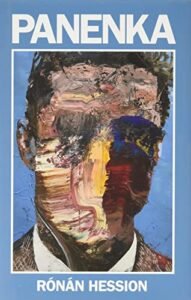
This is Hession’s second novel after the incredible, and now BBC adapted, Leonard and Hungry Paul. Here we follow the titular Panenka (real name Joseph) in his later life, based in the fictional town of Seneca. Even from the title and location alone you know football is involved somewhere and, given his style in his first novel, that Hession has kept his focus on people. We view their daily lives and interactions, rather than any overt focus on location through creation of soccer-loving, fictional Seneca. This is a location that brings to mind some of the off-brand European teams represented in the Pro Evolution Soccer video games.
Panenka is managing a difficult past (which also relates to the footballing nickname) but also a frightening and increasingly more certain future. He suffers from nightly attacks, known as ‘the iron mask’, a debilitating head and face pain that seems to be steadily worsening.
Panenka lives with his daughter Marie-Thérèse and grandson, Arthur. Panenka’s relationship with Marie-Thérèse’s mother having ended some time ago. The coming and going of relationships is a theme here: Panenka and ex-wife Lauren, as well as Marie-Thérèse and Vincent. Hession applies a customary light touch to deep messaging, as he is able to delicately explore the intricacies of strained and failing relationships: how Panenka and Lauren then in turn affect Marie-Thérèse, and how these ripples affect her best friend Carla and husband Vincent. These are the immediate relationships under scrutiny but Hession also touches upon the character Anthony and his wife who seems in deep depression, as well as Esther and ex-husband Eugene. Together, this is a wry set of case studies on family, love, strife and how they are balanced with the pressures of the exterior world.
Where Leonard and Hungry Paul leads the reader toward the sage, aspirational, and maybe unobtainable, way of living of Hungry Paul, Panenka feels more realistic. There is a concrete level of peril and suffering to this story blended with Hession’s relaxed friendly tone. I think adding in these tensions does make for an even stronger message; there is more polarity. Everything in Panenka is at a point of transition. Panenka’s illness, his new relationship with Esther, will Marie-Thérèse move away, will Vincent repair his marriage? Each hangs at a point of decision. There’s more of an adult feel to the problems and how to navigate through imperfectly.
To clarify, I absolutely love Leonard and Hungry Paul and especially Hungry Paul the character, with his slow mid-30s outlook, his lack of urgency or need for a self-sufficient way of living. Hungry Paul brings his temperament and deep character insight to bear on his family and friends; he provided zen-like one liners that cut to the quick of a problem. But, as far as we know, he has not overcome adversity, only Leonard has.
By contrast, in Panenka, each of the characters have lived lives and there are more strains; there has been suffering to their existence. For this reason they are more tangled; Hession expertly understands their inner workings through comforting prose, which never stretches into verbosity. He is precise, concise and has a tone that you’d expect to hear from a friend telling a story in a café or quiet pub.
Less is certainly more for Hession’s style: characters don’t need hefty backstories, surnames, or in the cases of Panenka and BABA the use of their first names. Remove the fluff, that’s what Hession is great at. Even the location is not determined. In Leonard and Hungry Paul, it feels as though the setting is some Dublin suburb, but Hession deliberately keeps Dublin out of the novel through anonymisation; Dublin is probably too big of a character to sit in beside Leonard and Hungry Paul.
In Panenka, we know of a fictitious location for the story, Seneca. I’m not entirely sure where it’s based, but it has the feeling of continental Europe: outdoor seating at cafés and an obsession with the small town football team, which modulates all local emotions and expectations. There’s also mention of rivals Olympik, again with the flavour of an off-brand of football game.
Panenka is a football term based on the audacious penalty kick of Antonín Panenka, where you chip the ball straight down the middle. To me, this has been most audaciously conducted by the majestic Andrea Pirlo. But although this is a football word, it is not a football book. Hession does, however, explore some of the attributes that football can bring to a community, some good in a unifying way but also some bad: ostracising of panto-football villains and the partitioning of unfair blame.
The relationship to the town is something Panenka has had to manage. The blame, the collective damnation has affected the latter part of his life, and in turn, those closest to him. The crowd turned on Panenka the footballer, and it damaged Panenka the person. This aspect of object vs. human reminded me of a Zadie Smith essay ‘Meet Justin Bieber’ from the collection Feel Free. Here, Smith discusses the elevation of famous people to a thing, rather than as a person. The I-it as opposed to the I-thou described by philosopher Martin Buber.
Hession strikes on an interesting and human point there. Football in general has quite a terrible reputation for villainising young sportspeople. But of course this is not endemic to football or even sport, and does serve as a reminder that behind the athlete or actor there is a person. You feel immensely for Panenka and hope for some improvement in any aspect of his life. Luckily for Panenka, there are lessons on connection and hope. Even in the most desperate of circumstances there are chances of small moments of gratitude, kindness and love.
At just under 200 pages, this is a short and punchy work from an author who can easily invert interiority into something amusing, warm and human. Panenka follows on extremely strongly from the high bar set by Leonard and Hungry Paul and I can’t recommend it enough.
D