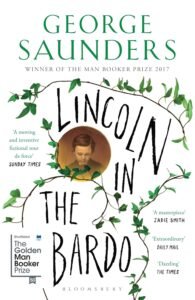
Winner of the 2017 Booker Prize, Lincoln in the Bardo is a story of loss and acceptance, or grief and understanding. Is there anything sadder than losing a child? It is against the natural order of things. In this work, Saunders explores the loss of Abraham Lincoln’s son, Willie, during the US Civil War.
After his passing, Willie’s spirit is left in the bardo, this in-between space where spirits linger before they are ready to pass on. The Bardo refers to an intermediate state in Buddhism, a sort of spiritual holding pen. Here, alongside Willie, we encounter a large cast of characters held throughout many ages of the United States. The main protagonists who tell the story are Hans Vollman, Roger Bevins III, and the Reverend Everly Thomas. Saunders writes this story through the eyes of others, with their parts of the story indicated afterwards. This is a unique, almost play-like way of storytelling and it adds to the ensemble feel.
To all characters, Saunders sprinkles over his quirky and comedic fairy dust. The main three have intriguing pasts which manifest in their appearance as spirits. Vollman (maybe as the name could suggest; Voll meaning full in German) appears with an engorged member, such was his anticipation just before death. Similarly, Bevins often looks fractured with multiple heads and limbs, likely due to his indecision at the end of his life. Probably the most notable in terms of looking post-bardo is the Reverend, who’s misdiscretions we are not privy to (or maybe it is because he has an additional role in the Bardo).
All of these spirits still resist transition onwards when the angels visit. They are guides to the next places, preceded by judgement. This change, from Bardo to having yourself weighed spiritually, is a part of a loud and light phenomenon called the matterlightblooming. Here, the angels recognise that the time of these spirits has passed, they are ‘waves that have crashed upon the shore’.
Whilst this is a moving depiction of grief, particularly embodied by Lincoln, there is also a lot of hope here; funny how the two extremes often co-habit. Vollman, Bevins, and the Reverend exert efforts to help the soul of Willie Lincoln: this isn’t a place for the young to linger, and they make every effort to try to help him move forward. The trio’s endeavours are powerful; there is transition, growth and redemption here too. All these efforts are wrapped in a slight unconventional strangeness to Saunder’s characters and even the way the book is written: the reporting-style form, which is particularly prominent in the exposition sequences commenting on the Lincoln family. I think there is a potential to find this stretching of the form slightly jarring, but I felt this added emphasis for the point of view and made the large cast more accessible. There are a multitude of different voices in this novel and so that style of delivery helps the reader differentiate, adding breadth and individuality.
Lincoln in the Bardo is quite a complex novel by virtue of the number of characters, and their individual motivations. But Saunders does an incredible job in balancing these lesser known voices with President Lincoln and his coping with the death of his son in the background. Lincoln manages grief, but also the idea of his son dying in the context of the Civil War, where many other sons would have to pay the same price. He weighs up whether this price is worth it, and what it means for those in bondage. Lincoln contemplates race and slavery, and Saunders positions his ruminations in the Bardo (with aid from the spirits lingering there) as a point of change for continuing the war for liberation.
This is a great story and a stretching of the form. An amazingly large character cast adds the cacophony of voices straining for validation and representation in the Bardo. I read the story first and then listened to the audiobook. Both have their virtues, but I would say the character cast for the audio version is amazing, and features a host of well-known names: David Sedaris, Keegan-Michael Key, Saunders himself, Ben Stiller, Miranda July, Bill Hader to name but a few.
D