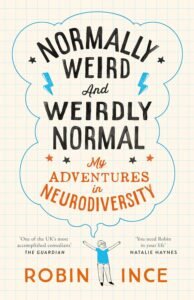
Build a world that fits all the people in it. That was Robin Ince’s rallying cry when I went to see him talk about Normally Weird and Weirdly Normal at the Taproom in Stockport, hosted by the great Serenity Booksellers. And isn’t this notion so very important at this moment in time.
2025 has felt increasingly as though levels of intolerance and exclusion have risen. This is not just intuition, but there are certainly facts attached: obsessions over immigration and small boats in the UK seem to dominate the political discourse. Horrendous movements against the trans community, when the highest threat to the safety of women are men (see NAO report 2025). Oh and of course, another round of book bans in the US. Books, and the ideas they contain are so very important.
Ince is then a brave and brilliant salmon swimming against the current. He wrote in my copy of Normally Weird, ‘Let’s make a world that is both weird and wide’. Precisely, we need tolerance, acceptance and empathy to create conditions for us all to thrive.
‘It is important to understand that while not everyone is neurodivergent, we are all neurodiverse. Neurodiversity is a way to understand the variety of ways human minds behave and react in, and to, the world.’
Normally Weird has come about after Ince received his attention deficit/hyperactivity disorder (ADHD) diagnosis at the age of 52. Hark, I’m sure we can already hear the common rebuttals of, ‘But what’s the point, there’s no cure’ and of course ‘it’s just a label and you’ve already got this far, so why is it necessary?’. But of course it is never so simple.
‘The label is for you to use how you wish, but with the label comes an instruction manual.’
Diagnosis even without cure (see at one end the very many and life-changing neurological diseases of Parkinson’s, Huntington’s and Alzheimer’s, and at the other end, the common cold) leads to prognosis, which leads to the access of a toolbox for the better understanding of yourself and the world you inhabit. In this case of ADHD specifically, a diagnosis may also add meaning to the broadening and/or narrowing (depends how you see it) of concentration alongside the emotional acuity that you or friends/family/peers/strangers may have experienced for their entire life.
‘Some people keep the illusion of keeping themselves together while unravelling for a lifetime’
Despite GPs voting that mental health illnesses are being over-diagnosed and Anthony Hopkins, someone with real cultural heft, weighing in unhelpfully, surely we need to adopt Ince’s view and look at the world, asking how it might have changed to drive up the cases, rather than assume that someone’s gone mad with the ADHD stamping machine. I’d like to believe that we have become better at detecting differences in how all our brains work and what’s best, individually, to keep them ticking along at their optimum. Weirdly Normal is a passage to understanding the broad umbrella terms of ADHD/autism spectral disorder (ASD), presented through Ince’s eyes.
Ince takes us through moments in his life leading up to his diagnosis and beyond. He speaks in his brilliantly balanced, open and candid style of early life trauma and its potential impact on neurological development. Ince recounts his struggles with anxiety, low self-worth and suicidal ideation. I found these moments exceptionally powerful and applaud Ince for his honesty and efforts to change our world for the better.
Each chapter covers a different fact that could be linked with ADHD and ASDs: attachment to objects, navigating love and relationships, and applying a strong sense of justice to a world that is certainly slow to catch up (if it is indeed trying…).
Ince, perhaps because of his polymath-like interest in the way the world works, and how we react to it, is an exceptional comedian. He observes, subverts and presents the world back at you humorously, layered with additional thought. Notably, he’s also trying to use these powers for good.
As to how the brains of comedians work, this forms the basis for his earlier work I’m a Joke and So Are You. I think you could well combine Weirdly Normal with I’m a Joke as a two-part exploration of the self, pre- and post-ADHD diagnosis; the two works look at both sides of the same coin and offer great insight charged with Ince’s wit, interest and self-reflection.
So of course, the answer to ‘Who is this book for?’ is everyone. If you or family or friends or colleagues see the world in a way that is consistent with what is now termed ADHD/ASD then this is a perfect book to understand, or at least start to unpick, how you feel and maybe why. Ince presents a very human road map of understanding. Because this is what we should be doing, isn’t it, being curious, open-minded and appreciative of the qualities that a wide range of different minds can bring to the world.
Maybe most importantly, this book is also for those who consider themselves the most median of neurotypical minds. Those akin to herd immunity who feel as though they have no contact or have never met anyone who sees the world that is different to their ‘normal’. This book is then a gentle challenge to that mentality and a prod in the direction of awareness and empathy, something that Gabor Maté has recently written about in the Guardian.
Because really, however you look at it, everyone is at least a bit weird. So what we definitely need is everyone to be aware, to recognise and to help wherever they can to build a world that fits all the people in it.
What a brilliant book from a great mind.
D