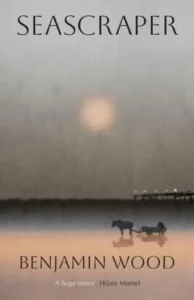
Seascraper was longlisted for the 2025 Booker Prize and, alongside Universality, was one of the shorter works on offer. Since then, this lovely svelte novel has won the Nero Book Award for fiction and been further nominated for the Walter Scott Prize (2026) for historical fiction, alongside the brilliant Helm.
Seascraper is set in a fictitious town in the North West of England, on the coast of the Irish Sea; a setting that is reminiscent of Wood’s native Southport. The novel follows Thomas Flett, our main character, through the mizzle and gloom during his work as a shrimp shanker. Surely the way in which Seascraper was written has influenced the evocative landscape described (Wood wrote large parts outside in the Church garden longhand, often in the rain). Flett uses traditional horse and cart methods to harvest his catch, despite other more automated methods being available. Seascraper is set around the 60s but never formally acknowledged. There are some clues, however, including the use of motorised vehicles, references to Henry Fonda and looking to the past of the Second World War and Korean War.
Wood sets a gentle and atmospheric scene as we follow Thomas Flett over his daily routine, through the damp and dreary drudgery. Like his grandfather before him, Thomas is a shanker, he goes out with the horse and cart to dredge up shrimp from the shallows, providing for his mother, with both father and grandfather no longer present. This is a scene of loyalty, routine and hardship which is suddenly disrupted by the arrival of a mysterious film-making stranger.
I wouldn’t want to spoil this excellent story with too many specifics but it is of course a turning point for Thomas to reflect on his own life: is there more than this grind? Or, at least, more that he enjoys or better compliments his abilities and inclinations.
The exploration of circumstance is interesting. Aren’t we all really quite tied to environment and situation, class being one such example? As Zadie Smith puts it in her essay collection Feel Free, ‘Class is a cocoon – it takes genius to think your way out of it.’ Wood explores this delicately in Seascraper, where Thomas Flett needs to provide for his mother, but he is also conflicted. Wood creates tension through the restrictions of the working class compared with artistic interests: Thomas needs to maintain loyalty to his mother and the working beliefs of his grandfather, but he is also imbued with an appreciation of the arts, for books and reading, from his absent father. Wood excellently balances the ideas of art and class and ultimately (and rightly) shows that one should not limit the other. The mysterious stranger, Edgar, seems to provide a way through that class boundary: from shanking to the arts and out to something more creative. But, like the prophetic shifting sands at the coast, this is only too good to be true.
With an artistic escape route disappearing, Wood does not paint a picture of desolation, rather transformation. Thomas is instead driven to apply himself to music; a means to build out his relationships and express love. Here, Wood stresses the power of arts for both escape and unification; something explored in another recent favourite Glorious Exploits by Ferdia Lennon. Thomas Flett expresses his love for his best friend’s sister, Joan, through music, and as part of the realisation of his own character, applies love through friendship to Edgar. These are moments where the restrictive boundaries dissolve and love, the greatest unifier, is all that remains.
A highlight of Seascraper was the excellent pacing of plot, wrapped around in humanness; there is a connection afforded through the simplicity of this novel that can sometimes be lost in more expansive works. Having recently read Saraswati and Universality (each excellent in their own right), which have more hard hitting contemporary political messages, it was refreshing to delve into Seascraper where the scope is less epic but just as moving for its concision.
What a wonderful book, and one of my favourite reads in 2025. I am very glad to see it doing so well in the awards. Not that it should necessarily impact on the content, but the cover is beautiful and perfectly sums up the feel of Seascraper.
D