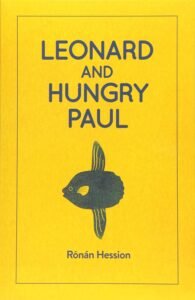
Sometimes books find you at the right place and time. It’s that time of year where the hustle and bustle has peaked and we are now in need of some peace and quiet. Leonard and Hungry Paul teaches everyone to break free from obligatory constraints and to operate in the peace of now; unshackle and unburden yourself from the stories in your head and just drift into the stillness. Stillness, quiet and gentleness are what this book is about.
Leonard and Hungry Paul is a story of two thirty-something year old friends moving through life at their own speeds and with their own agendas. The pair bond through board games, using the concentration generated during play to talk honestly of, well, almost anything – daily drudgery, up to the expanse of the universe. There is such a warm and wholesome tone to the story and, with its loving friendship as a base, it invites the reader to question their own situation and what is really of worth. As to why he’s called Hungry Paul, we’ll never know. Some questions just aren’t meant to be answered.
Leonard sadly loses his mother early on in the story and seeks solace with his closest friend, Hungry Paul, as well as through his work ghostwriting children’s encyclopaedias. This seems like quite a quirky but grounded job. It’s a role on the very precipice of creative freedom, a theme that’s explored in the new relationship with Shelley.
‘The job suited him as he was interested in pretty much everything and he preferred to play a minor part in someone else’s story rather than being his own star.’
The overall plot, focusses around a series of daily activities with a slow build up towards the wedding of Grace, Hungry Paul’s sister. In almost Wodehouse style, there are some lovely vignettes in this lead up, including Leonard’s date with Shelley and Hungry Paul’s chocolate debacle at the supermarket. For me the pacing is perfect and if you want to read a book without adrenaline but with lots of meaning, you can’t go far wrong. This is more of a character study and Hungry Paul is the centre piece around which the others seem to orbit.
Hungry Paul, seems transcended further from the normal planes of life. He does have a sage-like fulfilment in the now, and is happy to pick up Judo in his 30s, with occasional work for the postal service sprinkled in amongst spending time with his parents, Peter and Helen. For many, this is perhaps an illustration of someone with nothing ‘all together’: he has little financial independence and certainly no arbitrary drive towards fame and fortune (or at least security), the more conventional path we’re told to pursue in life. This is a path that his sister Grace is ardently trying to pave for him.
Grace worries that Hungry Paul’s lack of engagement means that in their dotage, the care of their parents will be left to her. She is a character embodying the culture we live in, focus on the future at the expense of the present. Luckily for Grace, she has Hungry Paul as a counterweight.
Hungry Paul believes the future will look after itself. He will make the key decisions when he needs to; there’s no use planning for any of the big worries until they are at your door. He’s very zen, in a three-Weetabix-a-day kind of way. Hession does render a modern day mindfulness master in Hungry Paul, a character who rejects the digital in favour of the quieter, analogue world.
‘Watch him the next time he spills something. His whole attitude is that it has already happened, and he just moves on to cleaning it up. He’s all about what’s going on now.’
There are also a number of nice motifs to remind us about slowing down and being present. Board games are the obvious one, with the added layer that there are no winners in their games, the means is the important part: it is just a vehicle for being present. Bird feeders are another. Hungry Paul restocks the bird feeders before his postie shifts in that moment of calm before the world starts up. Grace and Leonard also revert to feeding the birds at key moments of transition in their stories. I really like this, Hession highlights the simple pleasures away from all the hustle and bustle. A little bit of stillness can be all that’s required to set the mind on an easier course.
‘Leonard wore a new feeling of peace. He had always associated peace with the idea of happiness, as if it were some sort of steady state that happiness turned into when it was for real. But now he realised that peace was independent of any one feeling.’
In addition to the warming doses of day-to-day wisdom, this is a really funny book; it feels as though Hession had a lot of joy writing it. There is just so much heartwarming observation of daily life and he even manages to convey Leonard’s deep grief for the loss of his mother in such humane and gentle terms. Much like the characters, Hession hasn’t stretched too far in creating the world: we assume it’s set somewhere like Dublin but we never get that confirmation.
In a recent BBC Radio 4 book club episode, Hession talked about Leonard and Hungry Paul almost as an ode to the quiet people of the world; a message which is paraphrasing Hungry Paul’s statement around not making such a big impact on the world that you deface it. How refreshing today, when everyone seems to want more.
I hope it’s clear how much I love this book. It is a calm wholesome look at life through a witty and pastel hued lens – this world is not so shockingly bright but dampened and full of friendship and love. And we’ve had ‘Call me Ishmael’ and ‘It was the best of times; it was the worst of times’, but how about this for an opener:
‘Leonard was raised by his mother alone with cheerfully concealed difficulty, his father having died tragically during childbirth.’
Kudos to Bluemoose Books for picking this one up. Naturally, I think Hession’s other works Panenka and Ghost Mountain now demand to be read. But demand probably isn’t the appropriate word for Leonard and Hungry Paul. Warmly suggested then, as if by accident and coming from your own brain.
You may wish to note the above.
D