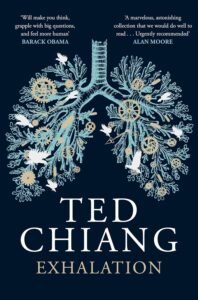
Firstly, if you get blurbed by Barack Obama, you’ve got my interest.
Exhalation is a collection of nine science fiction short stories. These are not space opera type sci-fi but very much more about human nature simply extrapolated into a science fiction landscape, many of which have a similar appearance to where we are in 2025.
If you’re a fan of the concepts shown in Black Mirror, without any of the harrowing or distressing parts, then this is a collection for you. Similarly, if you enjoy thinking around human nature and philosophical questions (‘what is life?’, ‘how to live in a world that will one day end?’, ‘what is the absolute truth and how should it be used?’), then Exhalation will prove very engaging.
Perhaps most relevant to 2025 and artificial intelligence is the story ‘The Lifecycle of Software Objects’. Set in a future where many more endangered species have been lost, and where people spend much of their free time in online digital worlds, a company creates artificial lifeforms, typically dressed in animal avatars. They are capable of speech and learning, for which the company is responsible before rehoming with human customers. All of this takes place in the digital world of ‘Data Earth’.
Chiang uses this setting to ask questions around sentience; are these digital creatures (called digients) equivalent to humans and should they therefore be afforded the same level of rights and protection? They can talk, learn and grow, so where is the distinction? Chiang looks forward to a future which is so very close to 2025: people now have relationships with chatbots and it doesn’t take a great leap of imagination to predict the digital entities will eventually be ported into real-world chassis. There is intriguing and cautionary foresight here.
The other issue raised in Chiang’s story is around longevity and ownership. Who owns these digital beings and who would care for them if the infrastructure changes? Similarly, as the digients progress to near sentience, how do we prevent their suffering and harm at the hands of users who do not treat them as living creatures? Again, all questions that are debated eloquently in this story and surely require legislation and debate in our own real Earth. Of course, laws are often reactive rather than prospective, meaning a great deal of harm could have already been done. It is often hard to predict what is totally correct.
Wrangling with the absolute truth and the more relative practical/pragmatic truth is the subject of ‘The Truth of Fact and the Truth of Feeling’. Here, Chiang compares two different stories across two time-periods: a modern day story where a brain device allows us to remember all the actions and conversations (digital indexing, if you will) and the other a historical setting where western Christian settlers are attempting to convert a tribal village.
In both stories we ask about the utility of recording. For the absolute truth can be useful; early writing allows for the maintenance of ideas, as long as the context to which these ideas refer is maintained. There is no ‘standing on the shoulders of giants’ if we have not recorded the word that went before. Again, Chiang plays with this concept with reference to human nature. Just because it is true, does not always mean that it is correct, the author posits. Ever more so in the contemporary story, a journalist examines his previous internal sense of self, his actions and the narrative he has believed. This is all brought into question once he has the means to objectively sieve through that experience, retrospectively. Again, there is a compromise to be had with selective memory, the fallible nature of organic neuronal matter versus enhanced silicon objective truth. Which, if any, is better and most useful to us? Something to contemplate.
In ‘The Merchant and Alchemist’s Gate’ Chiang tackles futures and their reflections into the past. A 1001 Tales Arabian setting is host to this brilliant story of love, loss and the many different paths that are happening around us.
‘Nothing erases the past. There is repentance, there is atonement, and there is forgiveness. That is all, but that is enough.’
The titular story ‘Exhalation’ is my favourite. This work covers thermodynamics, specifically the second law, where there is a tendency towards disorder, entropy, where energy reaches an equilibrium and a balanced state. We can most readily understand this through the movement of heat, essentially kinetic energy moving from an area of high energy to one of low. Or on a macro level, with something like the universe, an eventual ‘heat death’ where all energy stands at equilibrium, something Professor Brian Cox seems to regularly, and maybe gleefully, mention. In ‘Exhalation’, Chiang swaps heat for air and imagines a species of humanoid which only operates through air moving from high to low pressure. Underneath this premise is a beautiful and delicate story which asks how one should best live once you know everything will eventually end. In this case, once the air pressure balances out and the humanoids slow down, eventually leading to a cease of function. The patterns that you then make in the world, however fleeting, are so very important:
‘… because I am not that air, I am the pattern that it assumed, temporarily’
These are great, deep sci-fi short stories that make you examine what it is to be human, what we have and will stand for in a future of our making. I thoroughly recommend!
My arbitrary ranking after a single read is:
- Exhalation
- The Merchant and the Alchemist’s Gate
- Anxiety is the Dizziness of Freedom
- The Truth of Fact, The Truth of Feeling
- The Lifecycle of Software Objects
- Omphalos
- What’s Expected of Us
- The Great Silence
- Dacey’s Patent Automatic Nanny
D